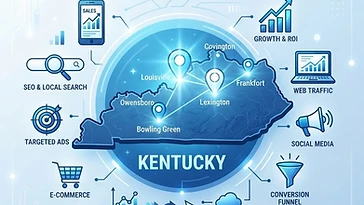
Winning the AI Search Shift Across the Commonwealth in 2026
Search behavior has fundamentally shifted. When a homeowner needs an emergency plumber in London, Kentucky, or a tourist seeks artisan dining in Berea, they are no longer just browsing traditional blue links. Instead, consumer discovery increasingly occurs directly within Google's AI Overviews, Apple Intelligence, ChatGPT Search, and Perplexity. In fact, more than 35% of consumers have used an AI engine to find a local service provider, yet over 88% of local companies have no active strategy to appear in these synthesized answers.
For Kentucky business owners, this gap represents the single largest digital marketing advantage of 2026. Traditional search optimization focused on stuffing keywords into title tags and tracking rankings. AI search optimization—often termed Generative Engine Optimization (GEO)—requires structuring your brand so large language models (LLMs) can retrieve, verify, and cite your business as the definitive regional authority.
Whether you operate an established manufacturing firm in Richmond or a multi-location healthcare clinic serving Corbin and Somerset, optimizing for AI engines ensures your business remains visible precisely when consumers ask conversational questions. The business that commands AI citations commands market share.
Why Conversational Queries Outperform Generic Keywords
Modern searchers no longer type fragmented phrases like "contractor Somerset KY." Instead, they prompt: "Who is the most reliable commercial roofing contractor near Somerset that offers 24-hour storm damage repairs?" Generative engines synthesize responses by pulling data from authoritative web ecosystems, verified review profiles, and structured local entities. To capture this business, your web footprint must be engineered for synthesis rather than passive scanning.
How AI Search Works: Retrieval, Entities, and Structured Context
To capture visibility in modern AI engines, business leaders must understand the mechanics behind generative search results. While traditional crawlers index pages to match query keywords, AI discovery operates on a multi-stage framework called Retrieval-Augmented Generation (RAG).
The Mechanics of Retrieval-Augmented Generation (RAG)
When a user submits a natural-language prompt, the AI engine does not rely solely on its static pre-trained weights. Instead, it follows a structured pipeline:
- Query Interpretation & Intent Parsing — The engine deconstructs the user prompt, identifying location constraints, service criteria, and implicit buying intent.
- Real-Time Web Retrieval — The engine scans trusted indexes for canonical facts, high-authority business mentions, and schema-verified local listings.
- Information Extraction & Entity Matching — The system extracts corroborating facts across directories, verifying that business names, categories, addresses, and offerings match consistently.
- Synthesis & Citation — The generative model drafts a concise, conversational answer, embedding direct attribution links to the sources it deems most authoritative.
The Central Role of Structured Schema Markup
AI algorithms prioritize structured certainty over ambiguous marketing text. Pages featuring explicit LocalBusiness and FAQPage schema are substantially more likely to be cited in AI Overviews compared to unstructured pages. Structured data acts as a direct translation layer, allowing AI bots to ingest your exact service boundaries, operating hours, accepted payments, and certifications without guesswork.
Coupling clean technical architecture with robust on-page answers ensures search engines understand your exact capabilities. A foundational investment in modern web design and fast, reliable hosting gives AI crawlers the unhindered access required to verify your enterprise.
The Kentucky Regional Context: Micro-Markets and Entity Consistency
Digital marketing across Kentucky requires an intimate understanding of our distinct regional hubs. A blanket marketing strategy that treats a rural trade market in Manchester the same as an institutional market in Richmond will consistently fall short. Generative engines are intensely localized; they weigh geographical proximity, regional citations, and local civic entity associations.
Navigating Eastern and Central Kentucky Micro-Markets
Across our Commonwealth, local commerce thrives on localized community reputation:
- Corbin, Williamsburg, and Barbourville — In the tri-county area of Whitley and Knox, consumers frequently travel along I-75 and US-25E for specialized medical, retail, and home improvement services. AI engines prioritize businesses that explicitly outline their cross-county service boundaries.
- Middlesboro and Pineville — Tucked in Bell County and the Cumberland Gap corridor, businesses must capture both local trade and interstate tourism. Verified reviews that highlight regional landmarks provide essential geo-signals.
- London and Somerset — As commercial, medical, and recreational epicenters near Lake Cumberland and Laurel Lake, these hubs demand comprehensive service catalogs and prompt booking interfaces.
- Richmond and Berea — Rapidly growing Madison County blends university culture, artisan tourism, and industrial expansion. AI answer engines prioritize agile businesses offering explicit pricing guidelines and deep community roots.
- Mount Vernon, Manchester, and Fort Knox — Niche markets spanning Rockcastle County, Clay County, and military-adjacent communities require distinct canonical facts pages reflecting true operational capabilities.
The Power of Hyperlocal Citations
AI search models evaluate how often your business entity is corroborated by trusted local directories. This is why prominent placement across regional authority platforms is paramount. Advertising on trusted local community resources—such as Richmond, Kentucky's city guide or Corbin's city guide—builds unbreakable entity authority.
OLA operates 12 dedicated municipal portals across the state, ranging from Barbourville and Manchester to London and Somerset. Leveraging our city guide advertising network delivers authentic, location-specific signals that AI engines view as third-party validation.
Step-by-Step Implementation: Engineering Your Kentucky AI Search Footprint
Transitioning your business from invisible to cited in AI-generated answers requires disciplined, technical execution. Implement this four-step blueprint to secure your generative search footprint in 2026.
Step 1: Establish Your Canonical Fact Sheet
Generative engines punish conflicting information. If your Google Business Profile lists an address in London as "Suite B" while your site lists "Unit 2" or an outdated phone number appears on Apple Maps, AI systems lose confidence in your data.
- Standardize NAP Data — Establish one exact, verified record for your Name, Address, Phone number, and hours.
- Audit Secondary Platforms — Harmonize your profiles on Yelp, Bing Places, Apple Business Connect, the Better Business Bureau, and local chambers of commerce.
- Align Primary Categories — Select the most granular primary business category on your Google Business Profile, avoiding generic categorizations that dilute relevance.
Step 2: Implement Advanced Local Schema Markup
Equip every core page of your website with nested JSON-LD structured data. Rather than relying on generic markup, use specific schema classes such as MedicalBusiness, LegalService, RoofingContractor, or HVACBusiness.
- ServiceArea Schema — Define the precise counties, zip codes, and Kentucky cities you serve (e.g., Laurel, Pulaski, Madison, Knox).
- FAQPage Schema — Add structured Q&A markup addressing common buyer objections, service limitations, and pricing models.
- SameAs Verification — Reference official social profiles, Chamber of Commerce listings, and city directory profiles inside your schema code to cement entity identity.
Step 3: Develop Answer-First, Localized Content
AI engines reward content structured to answer specific consumer questions concisely. Every service page should incorporate an "Answer-First" hierarchy:
- Define Solutions Within 40 Words — Open each service subsection with a direct, jargon-free summary answering what the service is, who it is for, and where it is delivered.
- Create Unique Location Hubs — If you serve multiple towns, do not clone duplicate content. Provide unique context on local regulations, terrain conditions, and community landmarks for your service areas.
- Integrate Search-Term Marketing — Align your on-page copy with natural-language voice prompts using strategic search term marketing.
Step 4: Cultivate a Real-Time Review Engine
AI engines treat customer reviews not just as star ratings, but as semantic data sources. Models scan review text to extract sentiment, verify specific service claims, and determine business responsiveness.
- Incentivize Descriptive Reviews — Encourage clients to mention the specific service performed and the Kentucky city where the work took place.
- Maintain 100% Response Coverage — Respond promptly to all customer reviews. An active, rapid response cadence demonstrates business reliability to both consumers and AI algorithms.
Common AI Search Optimization Mistakes Kentucky Businesses Must Avoid
Many organizations fail to achieve generative visibility because they apply outdated tactics to an evolving search environment. Avoid these critical missteps:
- Keyword Stuffing Conversational Copy — Cramming "plumber in London KY" twenty times into a page degrades readability and signals low quality to generative algorithms that prioritize natural language.
- Publishing Thin, Automated Doorway Pages — Cloning identical service pages for Richmond, Berea, and Mount Vernon while merely swapping the city name results in algorithmic suppression. Each local page must contain original case studies, authentic photography, and distinct customer value.
- Ignoring Google Business Profile Engagement — Treating your Google profile as a static listing rather than an active publishing platform diminishes your local footprint. Learn how to maintain profile momentum with our guide on mastering Google Business Profile for Kentucky businesses in 2026.
- Failing to Verify Technical Accessibility — If AI bots encounter slow server response times, complex JavaScript hurdles, or broken redirect loops, your site will be excluded from the retrieval candidate pool. Enterprise-grade web hosting is a fundamental prerequisite for continuous crawling.
Measuring Results: AI Search ROI and Key Performance Metrics
Measuring generative search visibility requires evolving beyond basic organic ranking spreadsheets. Because AI Overviews often provide immediate answers directly within the search interface, businesses must evaluate a broader scorecard.
Key Generative Metrics to Monitor
- AI Platform Referral Traffic — Track direct session referrals originating from platforms like ChatGPT, Perplexity, and Gemini inside Google Analytics 4.
- Brand Mentions & Citation Frequency — Audit monthly conversational queries across AI tools using fixed prompt tests (e.g., "Who is the top custom software developer in Southeastern Kentucky?") to monitor citation frequency.
- High-Intent Conversion Rates — Visitors arriving via AI synthesis typically exhibit significantly higher commercial intent. Monitor phone calls, form completions, and scheduled consultations via your contact page.
- Branded Search Lift — As your entity gains prominence in AI answers, track organic volume increases for your specific company name across your service territory.
Investing in modern AI search visibility delivers measurable, lasting returns. With OLA’s transparent monthly service packages, Kentucky businesses gain full access to technical schema implementation, local directory dominance, and entity optimization designed to scale revenue.
Lead the AI Revolution Across Kentucky
Search technology is advancing rapidly, but the fundamentals of local commerce remain unchanged: trust, authority, and clear communication win customers. In 2026, generative engines serve as the primary intermediaries between your business and Kentucky consumers searching for solutions.
By securing your canonical business facts, implementing advanced schema, cultivating authentic local reviews, and building deep regional authority through our 12 Kentucky city guides, you position your brand at the very top of the AI discovery funnel.
Don't leave your digital visibility to chance while competitors modernize. Schedule a free consultation booking with the On-Line Advertising team in London, Kentucky today, and let us build an AI search strategy that turns conversational prompts into lifelong customers.