E-commerce

Advanced E-commerce SEO Strategies for National Growth in 2026

Scale your online store with advanced e-commerce SEO and AI-driven personalization strategies designed for national market dominance in 2026.

On-Line Advertising, LLC
Aug 16, 2026
8 min read
1 sections
National
Advanced E-commerce SEO Strategies for National Growth in 2026

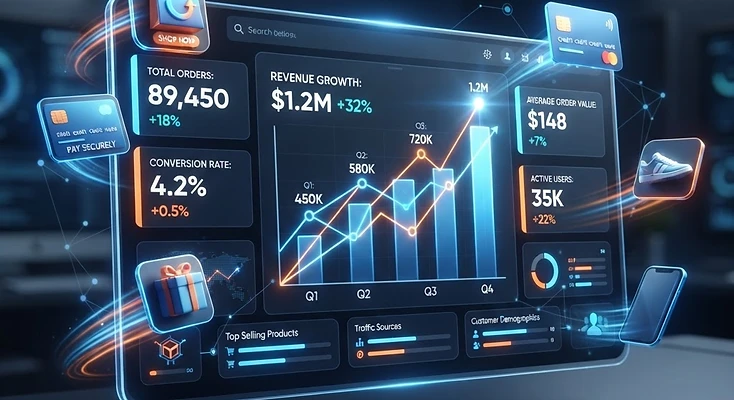
The E-commerce Evolution: Why 2026 is the Year of AI Integration\n\nThe landscape of digital retail has shifted from simple search-and-click transactions to a complex ecosystem of AI-driven discovery and automated decision-making. As we move through 2026, the opportunity for national e-commerce growth has never been more significant, particularly for brands that can bridge the gap between traditional search engines and the new era of generative answer engines. According to recent industry data, the global business-to-business e-commerce market is expected to grow at a compound annual growth rate (CAGR) of 14.5 percent through 2026, signaling a massive shift in how both consumers and professional buyers interact with online storefronts.\n\n### The Rise of Agentic Commerce\nOne of the most profound shifts in 2026 is the emergence of agentic commerce. This refers to AI agents—personal digital assistants—that perform product research and even execute purchases on behalf of the consumer. For a national brand to succeed, its digital presence must be optimized not just for human eyes, but for these autonomous agents that prioritize structured data and clear value propositions. Businesses that fail to adapt to this "machine-to-machine" commerce model risk losing visibility in the very places where modern consumers start their journeys.\n\n### B2B E-commerce Expansion\nWhile direct-to-consumer (DTC) models continue to evolve, the real growth frontier in 2026 lies in B2B digital transformation. Wholesale distributors and manufacturers are increasingly adopting digital marketing strategies that mirror the ease of use found in retail. This includes personalized pricing tiers, automated reordering systems, and deep integration with procurement software. At On-Line Advertising, LLC, we have seen that national B2B players who invest in these high-level e-commerce features often see a 30% increase in customer retention within the first year.\n\n## The Technical Foundation of Modern Online Retail\n\nTo compete on a national scale, your website must be more than just a catalog; it must be a high-performance data engine. The technical requirements for e-commerce in 2026 revolve around speed, semantic clarity, and cross-platform interoperability. This starts with a move away from generic templates toward custom-built environments that can handle the heavy lifting of AI processing without sacrificing user experience.\n\n### Generative Engine Optimization (GEO)\nTraditional SEO is no longer enough. In 2026, brands must master Generative Engine Optimization (GEO) to ensure their products appear in AI-generated summaries and recommendations. This involves creating content that directly answers complex user queries and providing the "why" behind a product's superiority. Our team at OLA specializes in search term marketing that targets these generative results, ensuring your brand is the one cited by AI assistants when a user asks for the "best sustainable outdoor gear for high-altitude hiking."\n\n### Structured Data and Schema Markup\nStructured data is the language of 2026 e-commerce. By implementing advanced Schema.org markup, you provide search engines and AI models with explicit details about your products, including real-time inventory levels, shipping speeds, carbon footprint metrics, and verified user reviews. This technical layer is what allows your product to appear in rich snippets, voice search results, and automated comparison tables. Without robust structured data, your store is essentially invisible to the most advanced search technologies currently in use.\n\n## Scaling Across the United States: A National Strategy\n\nOperating a national e-commerce brand from a central hub—whether you are based in a major metro area or headquartered in London, Kentucky like OLA—requires a strategy that accounts for the vast diversity of the US market. National scaling is not about being everything to everyone; it is about using data to identify and dominate specific niches across different geographic regions.\n\n### Competing in Diverse US Markets\nConsumer behavior in the Pacific Northwest differs significantly from that in the Southeast. A successful national strategy in 2026 uses AI-driven analytics to localize the shopping experience without needing physical storefronts in every state. This includes dynamic content that adjusts based on the user's location, highlighting products relevant to their local climate, culture, or economic trends. For example, a national clothing retailer might use predictive modeling to feature heavy outerwear to users in New England while simultaneously promoting lightweight linens to customers in Arizona.\n\n### Leveraging National Logistics and Trust\nTrust is the currency of national e-commerce. To compete with giants like Amazon, smaller national brands must emphasize their unique value and reliability. This is achieved through transparent logistics—providing real-time tracking and multiple shipping options—and by building a brand story that resonates across state lines. By utilizing e-commerce sites that integrate seamlessly with national 3PL (third-party logistics) providers, businesses can offer the "big brand" experience while maintaining the personalized touch of a specialized retailer.\n\n## Actionable Steps to Scale Your Store in 2026\n\nScaling a business requires a methodical approach to both technology and marketing. If you are looking to take your store from a regional player to a national powerhouse, follow this implementation roadmap:\n\n- Audit Your Technical Debt — Before scaling, ensure your current platform can handle increased traffic and data complexity. Transitioning to Managed Web Hosting is often the first step in ensuring 99.9% uptime during high-volume national sales events.\n- Implement AI-Powered Personalization — Use machine learning tools to analyze visitor behavior and provide real-time product recommendations. In 2026, "customers also bought" is basic; you need "based on your recent search for sustainable materials, you might prefer these items."\n- Optimize for Voice and Visual Search — Ensure your product images are high-resolution and tagged with descriptive alt-text for visual search engines. Simultaneously, refine your product descriptions to match the natural language patterns used in voice search.\n- Deploy Hyper-Local Advertising — Even as a national brand, your advertising should feel local. Use geo-fencing and localized ad copy to speak directly to the needs of specific US markets, increasing your relevance and conversion rates.\n- Strengthen Social Proof — Aggregate reviews, user-generated content, and expert endorsements. In a national market, shoppers look for validation from people like them, regardless of where they are located.\n\n## Common Pitfalls in National E-commerce Scaling\n\nEven the most well-funded brands can stumble when expanding nationally. Avoiding these common mistakes will save your business time and capital:\n\n- Neglecting Mobile-First Journeys — In 2026, the majority of national e-commerce transactions occur on mobile devices. If your checkout process has more than three steps or requires excessive typing, your abandonment rate will skyrocket.\n- Ignoring Site Speed — Every millisecond of delay costs money. National brands often fail because their sites are bloated with unoptimized scripts that slow down the experience for users with slower connections in rural areas.\n- Fragmented Data Silos — If your marketing data doesn't talk to your inventory data, you will eventually sell products you don't have in stock or market to the wrong audience. Integration is key to a seamless national operation.\n- Underestimating Customer Support — Scaling nationally means dealing with multiple time zones and diverse customer expectations. Failing to provide 24/7 support—often through AI-powered chatbots—can lead to a rapid decline in brand reputation.\n\n## Measuring Success: ROI and Key Performance Indicators\n\nIn the high-stakes world of national e-commerce, you must track the metrics that actually drive growth. Moving beyond "vanity metrics" like page views, focus on these high-impact KPIs:\n\n- Average Order Value (AOV) — Increasing AOV is often more cost-effective than acquiring new customers. Track how personalization and bundling strategies impact the total spend per transaction.\n- Customer Acquisition Cost (CAC) by Region — Analyze which parts of the US are most expensive to break into. This allows you to reallocate your budget to markets where your brand has the highest resonance and lowest competition.\n- Customer Lifetime Value (CLV) — The goal of national scaling is to build a loyal base. Measure how often customers return and what their total value is over a 12-to-24-month period.\n- Conversion Rate by Device and Channel — Understand exactly where your sales are coming from. If your social shopping conversion is high but your organic search conversion is low, you know exactly where to focus your optimization efforts.\n\n## Conclusion: Future-Proofing Your E-commerce Brand\n\nThe path to national e-commerce dominance in 2026 is paved with data, AI, and a relentless focus on the user experience. By embracing GEO, optimizing for agentic commerce, and maintaining a robust technical foundation, businesses can transcend geographic boundaries and compete at the highest levels. Whether you are a small business looking to make your first national sale or an established brand seeking to optimize your ROI, the strategies outlined here provide the blueprint for success.\n\nAt On-Line Advertising, LLC, we specialize in helping businesses across the United States navigate these complex digital waters. From our headquarters in Kentucky, we provide the national expertise and custom solutions needed to turn your e-commerce vision into a scalable reality. Ready to take the next step? Free consultation booking is available to help you map out your 2026 growth strategy.

Share this article
FAQ

Frequently AskedQuestions

Take the Next Step

Put These InsightsInto Action

Ready to grow your business? Explore our services, see our work, or book a free consultation today.